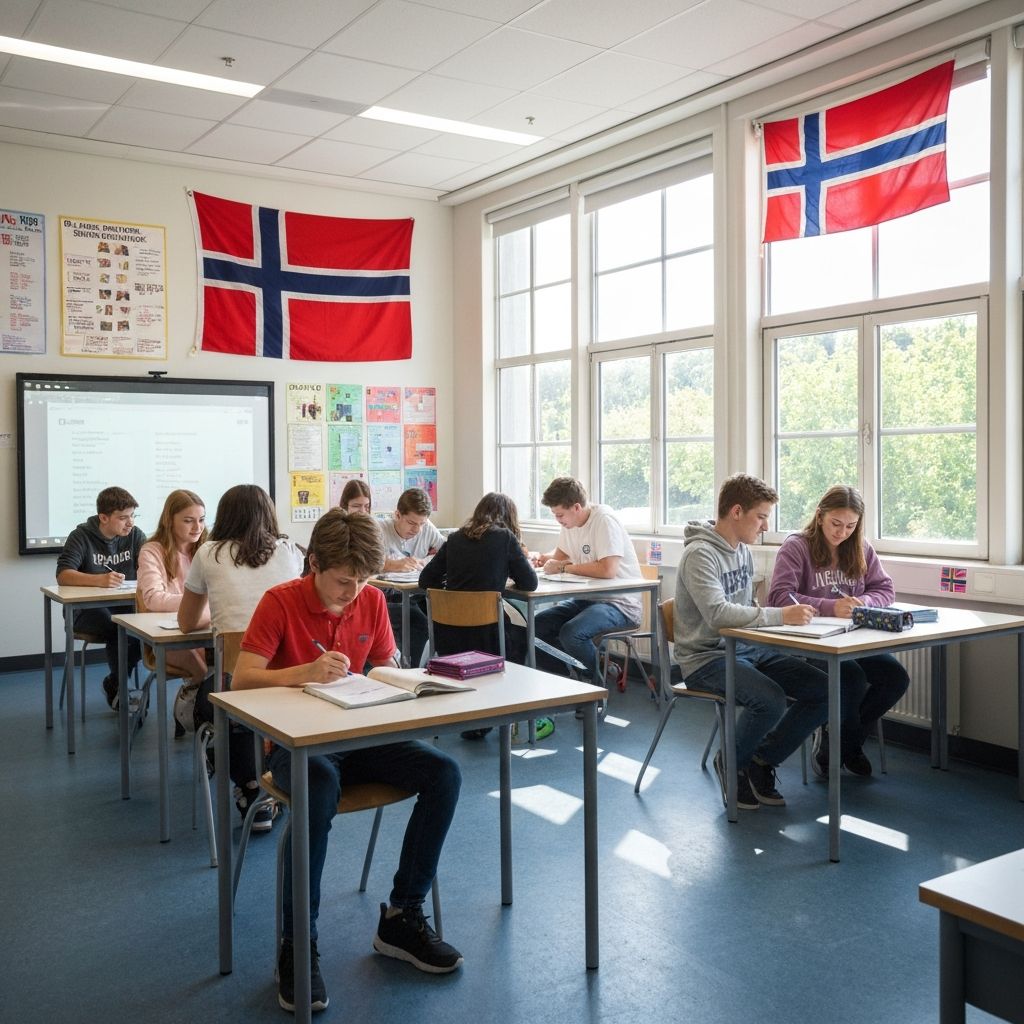
You can get remarkably far in Norway on a single word: takk. It means thanks, it works almost everywhere, and Norwegians deploy it constantly. But if you only ever say takk, you will miss half of how gratitude actually functions here, because Norwegian has a whole set of situation-specific thank-yous that carry real social weight. Say the right one at the right moment and you will watch a reserved Norwegian visibly warm up.
This is your practical toolkit: the core words, the specialised phrases that matter most, and how to pronounce them without giving yourself away as a total beginner.
Quick reference: saying thanks in Norwegian
- Takk — thanks (short a, hard k: "tahk").
- Tusen takk — a thousand thanks; thank you very much.
- Takk for maten — thanks for the food; say it after any meal.
- Takk for sist — thanks for the last time; say it when you meet again.
- Takk for i dag — thanks for today; end of a shared day or class.
- Takk skal du ha — a warmer, fuller thank-you.
The building block: takk
Everything starts with takk. On its own it covers thanks and, with a nod, you are welcome-adjacent politeness. Scale it up with tusen takk, literally a thousand thanks, which is the natural way to say thank you very much and probably the single most useful phrase in this article. Want more warmth? Mange takk (many thanks) and takk skal du ha (roughly, thanks shall you have) both add sincerity. For over-the-top gratitude, tusen hjertelig takk piles on the heartfelt.
One quirk worth knowing: Norwegians often use takk where English speakers would say please. Ask for a coffee and tack on takk and you sound polite and local at once. There is no everyday word that maps cleanly onto please, so takk quietly does that job too.
"In Norwegian, takk is please, thanks, and social lubricant all at once. Learn to sprinkle it everywhere and you are already halfway to sounding polite."
Takk for maten: the one you cannot skip
If you learn only one phrase beyond takk, make it takk for maten, thanks for the food. You say it to whoever cooked or hosted, immediately after a meal, and in a Norwegian home it is close to mandatory. Children are drilled in it from toddlerhood. Forgetting it at someone's dinner table is a genuine social misstep, the kind a host will notice even if they say nothing. The reply is usually a modest vel bekomme, the Norwegian equivalent of you are welcome or bon appétit's cousin.

Takk for sist: the phrase with no English twin
Here is the one that delights newcomers. When you meet someone again after previously spending time together, whether last night or last year, you greet them with takk for sist, thanks for the last time. It acknowledges your shared history and signals that the earlier occasion mattered. There is no clean English equivalent, and using it correctly is a small marker that you understand how Norwegian social life is stitched together. A close cousin, takk for i går (thanks for yesterday), does the same job for a more recent occasion.
Thanks for the occasion: a phrase for everything
Norwegian loves the takk for [something] construction, and it is worth collecting a few. Takk for i dag (thanks for today) closes out a class, a workday or a day spent together. Takk for hjelpen (thanks for the help) does exactly what it says. Takk for laget (thanks for the company) marks the end of a good gathering. Takk for turen (thanks for the trip) wraps a hike or an outing. Each one attaches gratitude to a specific shared experience, which is very much in keeping with a culture where connection is built through doing things together rather than through chatty small talk.
How to actually pronounce them
Pronunciation is where beginners give themselves away, so get the anchor right. Takk is one crisp syllable: a short, clipped a like the a in father, and a firm k. Think tahk, not taahk. Tusen takk is roughly TOO-sen tahk. The trick across all of these is to keep the vowels short and the consonants clean; Norwegian rewards a light, quick delivery over a drawn-out one. Building the sounds properly is exactly the kind of thing our guide to learning Norwegian is designed to help with, and hearing a native speaker run through the options makes it click faster:
How to respond when someone thanks you
Gratitude runs both ways, so you also need the replies. The warm all-purpose response is bare hyggelig, literally just pleasant, meaning my pleasure. Ingen årsak (no reason, that is, no need to thank me) is the equivalent of no problem. When someone says takk for maten to you as the cook or host, the set reply is vel bekomme, roughly you are welcome or may it do you good. And after a shared occasion, you can mirror a takk for sist right back at the person who said it. String a few of these together and you can hold up your end of a very Norwegian exchange: a soft volley of thanks and you-are-welcomes that says, without any small talk at all, that things went well. That quiet reciprocity is Norwegian politeness in miniature, and picking it up early makes you far easier to warm to.
Common questions about saying thanks in Norwegian
How do you say thank you in Norwegian?
The basic word is takk, said like tahk. For a bigger thanks, use tusen takk, a thousand thanks, the everyday thank you very much.
What does takk for maten mean?
Thanks for the food. You say it to the cook or host right after a meal, and in Norwegian homes it is close to obligatory.
What is takk for sist?
Thanks for the last time, said when you meet someone again after previously spending time together. There is no direct English equivalent.
How do you pronounce takk?
Like tahk: a short, clipped a and a firm k, all in one syllable. Tusen takk is roughly TOO-sen tahk.
Gratitude is one of the friendliest doors into Norwegian. Keep going with our guide to learning the language, and get the culture behind the words with our piece on Norwegian stereotypes.